Showing posts with label Unit 06 : Energy Work and Power. Show all posts

Sunday, August 1, 2010

Power

Power

The quantity work has to do with a force causing a displacement. Work has nothing to do with the amount of time that this force acts to cause the displacement. Sometimes, the work is done very quickly and other times the work is done rather slowly.


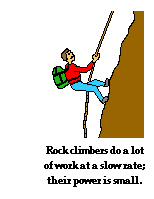
For example, a rock climber takes an abnormally long time to elevate her body up a few meters along the side of a cliff. On the other hand, a trail hiker (who selects the easier path up the mountain) might elevate her body a few meters in a short amount of time. The two people might do the same amount of work, yet the hiker does the work in considerably less time than the rock climber. The quantity which has to do with the rate at which a certain amount of work is done is known as the power. The hiker has a greater power rating than the rock climber.


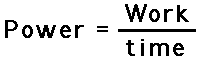
Power is the rate at which work is done. It is the work/time ratio. Mathematically, it is computed using the following equation.


The standard metric unit of power is the Watt. As is implied by the equation for power, a unit of power is equivalent to a unit of work divided by a unit of time. Thus, a Watt is equivalent to a Joule/second.

We can rearrange the equations:

W = Power x time
Energy = Power x time

1. Two physics students, Will N. Andable and Ben Pumpiniron, are in the weightlifting room. Will lifts the 100-pound barbell over his head 10 times in one minute; Ben lifts the 100-pound barbell over his head 10 times in 10 seconds. Which student does the most work? ______________ Which student delivers the most power? ______________ Explain your answers.


Answer


2. During a physics lab, Jack and Jill ran up a hill. Jack is twice as massive as Jill; yet Jill ascends the same distance in half the time. Who did the most work? ______________ Who delivered the most power? ______________ Explain your answers.


Answer


3. A tired squirrel (mass of approximately 1 kg) does push-ups by applying a force to elevate its center-of-mass by 5 cm in order to do a mere 0.50 Joule of work. If the tired squirrel does all this work in 2 seconds, then determine its power.


Answer


4. When doing a chin-up, a physics student lifts her 42.0-kg body a distance of 0.25 meters in 2 seconds. What is the power delivered by the student's biceps?


Answer


5. Your household's monthly electric bill is often expressed in kilowatt-hours. One kilowatt-hour is the amount of energy delivered by the flow of l kilowatt of electricity for one hour. Use conversion factors to show how many joules of energy you get when you buy 1 kilowatt-hour of electricity.


Answer


6. An escalator is used to move 20 passengers every minute from the first floor of a department store to the second. The second floor is located 5.20 meters above the first floor. The average passenger's mass is 54.9 kg. Determine the power requirement of the escalator in order to move this number of passengers in this amount of time.


Answer

Work Done

Work Done


When a force acts upon an object to cause a displacement of the object, it is said that work was done upon the object. There are three key ingredients to work - force, displacement, and cause. In order for a force to qualify as having done work on an object, there must be a displacement and the force must cause the displacement

"Work done" is another way of saying "energy transferred".
Work done = Energy transferred.
W = E

The equation which connects work, force and distance is

Work done = Force x Distance.
W = F x d


The equation can also be written as

Energy = Force x Distance.

E = F x d

In words:

Work done by a constant force on an object is given by the product of the force and the distancce moved by the object in the direction of the force.

Whenever a new quantity is introduced in physics, the standard metric units associated with that quantity are discussed. In the case of work (and also energy), the standard metric unit is the Joule (abbreviated J). One Joule is equivalent to one Newton of force causing a displacement of one meter. In other words,
The Joule is the unit of work.
1 Joule = 1 Newton * 1 meter
1 J = 1 N * m

Cases where no work is done:

1. Work is not done when The direction of the applied force and the direction in which the object moves are perpendicular to each other.
2.Work is zero if applied force is zero (W=0 if F=0): If a block is moving on a smooth horizontal surface (frictionless), no work will be done. Note that the block may have large displacement but no work gets done.
3.Work done is zero when displacement is zero. This happens when a man pushes a wall. There is no displacement of the wall. Thus, there is no work done.

In order to accomplish work on an object there must be a force exerted on the object and it must move in the direction of the force.


In summary, work is done when a force acts upon an object to cause a displacement. Three quantities must be known in order to calculate the amount of work. Those three quantities are force, displacement and the angle between the force and the displacement.

MECHANICAL ENERGY


In the process of doing work, the object which is doing the work exchanges energy with the object upon which the work is done. When the work is done upon the object, that object gains energy. The energy acquired by the objects upon which work is done is known as mechanical energy.
The two types of Mechanical energy that a body may have are Kinetic Energy and Gravitational Potential energy.

Kinetic Energy


Kinetic energy is the energy of motion. An object which has motion - whether it be vertical or horizontal motion - has kinetic energy. Whereas An Object which is stationary does not have any kinetic energy. When a force moves an object, it does work and it gains kinetic energy.
Hence, we can see that the kinetic energy of the object is due to the work done by the force.


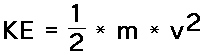
The amount of translational kinetic energy (from here on, the phrase kinetic energy will refer to translational kinetic energy) which an object has depends upon two variables: the mass (m) of the object and the speed (v) of the object. The following equation is used to represent the kinetic energy (KE) of an object.


where m = mass of object

v = speed of object

This equation reveals that the kinetic energy of an object is directly proportional to the square of its speed.

Kinetic energy is a scalar quantity; it does not have a direction. Unlike velocity, acceleration, force, and momentum, the kinetic energy of an object is completely described by magnitude alone.

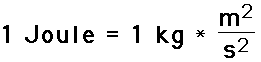
Like work and potential energy, the standard metric unit of measurement for kinetic energy is the Joule. As might be implied by the above equation, 1 Joule is equivalent to 1 kg*(m/s)^2.


We can see that for two objects of the same mass moving at different speeds ,the faster object has a greater kinetic energy.Similarly, for two objects of different masses moving at different speeds, the object of greater mass has greater kinetic energy.

Check Your Understanding

1. Determine the kinetic energy of a 625-kg roller coaster car that is moving with a speed of 18.3 m/s.

Answer

2. If the roller coaster car in the above problem were moving with twice the speed, then what would be its new kinetic energy?

Answer

3. Missy Diwater, the former platform diver for the Ringling Brother's Circus, had a kinetic energy of 12 000 J just prior to hitting the bucket of water. If Missy's mass is 40 kg, then what is her speed?


Answer


4. A 900-kg compact car moving at 60 mi/hr has approximately 320 000 Joules of kinetic energy. Estimate its new kinetic energy if it is moving at 30 mi/hr. (HINT: use the kinetic energy equation as a "guide to thinking.")

Answer

Potential Energy

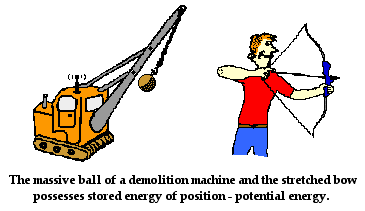
An object can store energy as the result of its position. For example, the heavy heavy ball of a demolition machine is storing energy when it is held at an elevated position. This stored energy of position is referred to as potential energy.

Similarly, a drawn bow is able to store energy as the result of its position. When assuming its usual position (i.e., when not drawn), there is no energy stored in the bow.

Yet when its position is altered from its usual equilibrium position, the bow is able to store energy by virtue of its position. This stored energy of position is referred to as potential energy. Potential energy is the stored energy of position possessed by an object.

border="0" alt="" />

Gravitational Potential Energy

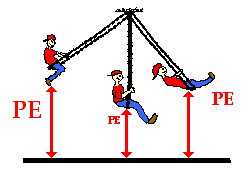
The two examples above illustrate the two forms of potential energy to be discussed in this course - gravitational potential energy and elastic potential energy. Gravitational potential energy is the energy stored in an object as the result of its vertical position or height. The energy is stored as the result of the gravitational attraction of the Earth for the object. The gravitational potential energy of the massive ball of a demolition machine is dependent on two variables - the mass of the ball and the height to which it is raised. There is a direct relation between gravitational potential energy and the mass of an object.

These relationships are expressed by the following equation:

PEgrav = mass * g * height
PEgrav = m * g * h


In the above equation, m represents the mass of the object, h represents the height of the object and g represents the acceleration of gravity (9.8 m/s/s on Earth).

More massive objects have greater gravitational potential energy. There is also a direct relation between gravitational potential energy and the height of an object. The higher that an object is elevated, the greater the gravitational potential energy.

Since the gravitational potential energy of an object is directly proportional to its height above the zero position, a doubling of the height will result in a doubling of the gravitational potential energy. A tripling of the height will result in a tripling of the gravitational potential energy.


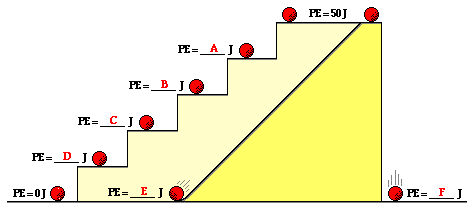
Use this principle to determine the blanks in the following diagram. Knowing that the potential energy at the top of the tall platform is 50 J, what is the potential energy at the other positions shown on the stair steps and the incline?


ANS


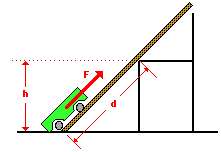
1. A cart is loaded with a brick and pulled at constant speed along an inclined plane to the height of a seat-top. If the mass of the loaded cart is 3.0 kg and the height of the seat top is 0.45 meters, then what is the potential energy of the loaded cart at the height of the seat-top?


ANS


2.2. If a force of 14.7 N is used to drag the loaded cart (from previous question) along the incline for a distance of 0.90 meters, then how much work is done on the loaded cart?
Saturday, July 31, 2010

Principle of Conversion of Energy

The Conversion law States:

The amount of energy remains constant and energy is neither created nor destroyed. Energy can be converted from one form to another (potential energy can be converted to kinetic energy) but the total energy within the domain remains fixed.

If you take any volume of space, then the total energy inside that volume at a given time is always the amount that was there earlier, plus the total amount that has come in through the surface, minus the total amount that has gone out through the surface.

Albert Einstein's theory of relativity shows that energy and mass are the same thing, and that neither one appears without the other. Thus in closed systems, both mass and energy are conserved separately.

The new feature of relativistic physics is that "matter" particles (such as those constituting atoms) could be converted to non-matter forms of energy, such as light; or kinetic and potential energy (example: heat).

However, this conversion does not affect the total mass of systems, since the latter forms of non-matter energy still retain their mass through any such conversion.


Examples of Conversion of Energy:


For instance, a coal-fired power plant involves these power transfers:

1. Chemical energy in the coal converted to thermal energy
2. Thermal energy converted to kinetic energy in steam
3. Kinetic energy converted to mechanical energy in the turbine
4. Mechanical energy of the turbine converted to electrical energy, which is the ultimate output


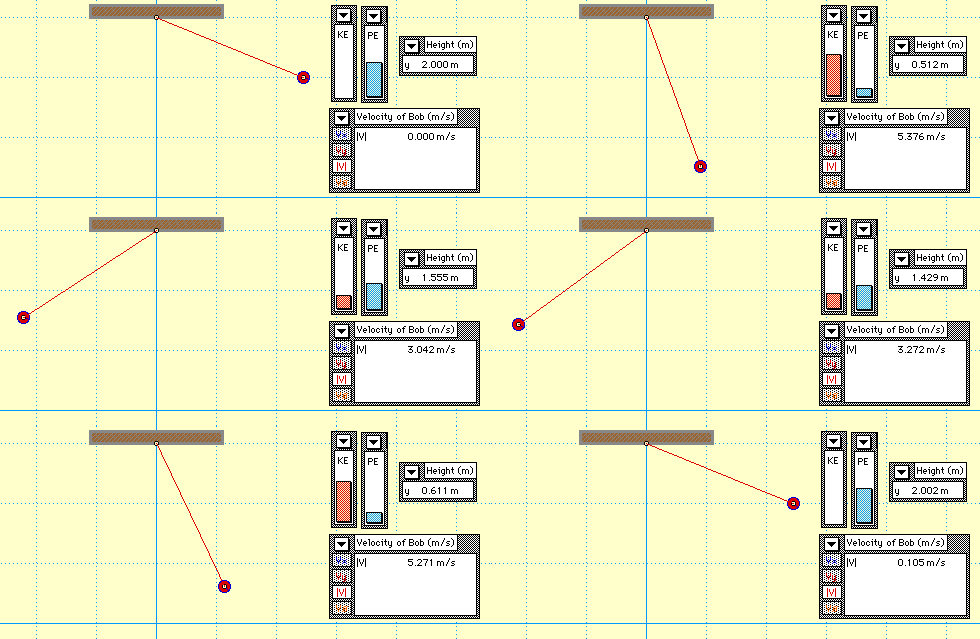
The motion of a pendulum is a classic example of mechanical energy conservation. A pendulum consists of a mass (known as a bob) attached by a string to a pivot point.

As the pendulum moves it sweeps out a circular arc, moving back and forth in a periodic fashion. Neglecting air resistance (which would indeed be small for an aerodynamically shaped bob), there are only two forces acting upon the pendulum bob.


In this animation, you see a mass attached to the end of a string which forms a pendulum. The pendulum begins with only gravitational potential energy (GPE) since it is not moving yet. After being released, GPE is turned into kinetic energy (KE). Notice that no matter where the pendulum is, the sum of the GPE and KE is always equal to the original amount of energy the system started with. This demonstrates the Law of Conservation of Energy.
Energy is Conserved)

Questions:

* Where does the pendulum have the highest velocity?
* How does the original height of the pendulum compare to its final height?

This Animation and illustration shows an ideal situatuation.However, using our common sense we know that it's impossible for the pendulum to swing higher than the
height h without giving it a push yourself. If there was no friction, the pendulum would swing back and forth forever because of the law of conservation of energy.

In reality, we know that eventually the pendulum comes to a stop.This is due to the frictional forces.As the pendulum swings, some of its total energy is converted to thermal energy due to frictional forces and dissipated to the surroundings and cannot be converted back to the kinetic or gravitational energy.The thermal energy must have come from the original gain in gravitational potential energy.


Hence, as a result , the pendulum bob cannot attain its initial height. It continues to lose its energy.When all its original gain in potential energy has been converted to thermal energy, the pendulum bob stops moving.

Efficiency:

We all use devices every day that use energy - or more accurately, transfer energy from one form to another. Everything we use wastes energy - some of the energy transfers into forms that are not useful to us.

Very few devices can transfer energy from one form into another without wasting some on the way.

For Example, A light bulb is designed to turn electrical energy into light energy. But most bulbs produce a lot of heat energy too. That energy has not been lost but it has been wasted.

To measure the efficiency of a device, calculate what percentage of the total energy put in, became useful output energy.


For example: a bulb is provided with 100J of electrical energy but only produces 20J of light. The fraction turned into light is 20J out of 100J = 20/100.


In percentages, that's 20/100 x 100% = 20%.

So the equation for efficiency is:

efficiency (%) = (useful energy out ÷ total energy in) x 100.

Efficiency is normally calculated as a percentage - something 90% efficient is considered good at its job. Devices that transfer only 5% of the energy they use into something useful are inefficient (very wasteful).

When energy is transferred,some of the energy turns into forms we don't want.

This energy is called wasted energy.

Wasted energy takes the form of heat and sometimes sound or light.

During any energy transfer, some energy is changed into heat.The heat becomes spread out into the environment.

This dispersed energy becomes increasingly difficult to use in future energy transfers.In the end, all energy is transferred into heat.

Efficiency is not the same as cost-effectiveness.

Wednesday, July 28, 2010

Energy, Work and Power

Energy


Energy can be defined as the capacity for doing work
.In physics we say that work is done on an object when you transfer energy to that object.

If one object transfers (gives) energy to a second object, then the first object does work on the second object.

Work can be generally defined as transfer of energy.

Work and energy are mutually connected and must be considered together as work is often defined in terms of energy and vice versa.In other words, Work shifts energy from one system to another.

The S.I. Unit of Work is the Joule(J).


In summary,

Energy is …

* a scalar quantity,
* abstract and cannot always be perceived,
* given meaning through calculation,
* a central concept in science.

Different forms of energy

Energy can exist in many different forms. All forms of energy are either kinetic or potential. The energy associated with motion is called kinetic energy. The energy associated with position is called potential energy. Potential energy is not "stored energy". Energy can be stored in motion just as well as it can be stored in position. Is kinetic energy "used up energy"?

You should be able to recognise the main types of energy. One way to remember the different types of energy is to learn this sentance where each capital and highlighted letter is the first letter in the name of a type of energy;

Most Kids Hate Learning GCSE Energy Names

Types of Energy

Magnetic - Energy in magnets and electromagnets.

Kinetic - The energy in moving objects. Also called movement energy.

Heat - Also called thermal energy.

Heat is the movement of molecules. It is the sum of the kinetic energy of an object's molecules. In many physics textbooks, they look at heat as some sort of substance and heat energy as something independent of kinetic energy. In our lessons, it is just one subset of kinetic energy.
Electrical energy

Light - Also called radiant energy.Light is the movement of waves and/or light particles (photons). It is usually formed when atoms gain so much kinetic energy from being heated that they give off radiation. This is often from electrons jumping orbits and emitting moving photons.
Nuclear energy


Gravitational potential - Stored energy in raised objects.

Chemical - Stored energy in fuels, foods and batteries.
Chemical energy is potential energy until the chemical reaction puts atoms and molecules in motion. Heat energy (KE) is often the result of a chemical reaction.
Light energy


Sound - Energy released by vibrating objects.

Electrical - Energy in moving or static electric charges.

Electrical energy is the movement of electrons. That is kinetic energy. The voltage in an electrical circuit is the potential energy that can start electrons moving. Electrical forces cause the movement to occur.
Chemical energy

Elastic potential - Stored energy in stretched or squashed objects.

Nuclear - Stored in the nuclei of atoms.

Certain elements have potential nuclear energy, such that there are internal forces pent up on their nucleus. When that potential energy is released, the result is kinetic energy in the form of rapidly moving particles, heat and radiation.

(The most commonly applied forms of energy will be discussed.)


Summary

* kinetic energy — motion
o mechanical energy — motion of macroscopic systems
+ machines
+ wind energy
+ wave energy
+ sound (sonic, acoustic) energy
o thermal energy-- motion of particles of matter
+ geothermal energy
o electrical energy — motion of charges
+ household current
+ lightning
o electromagnetic radiation — disturbance of electric and magnetic fields (classical physics) or the motion of photons (quantum physics)
+ radio, microwaves, infrared, light, ultraviolet, x-rays, gamma rays
+ solar energy
* potential energy — position
o gravitational potential energy
+ roller coaster
+ waterwheel
+ hydroelectric power
o electromagnetic potential energy
+ electric potential energy
+ magnetic potential energy
+ chemical potential energy
+ elastic potential energy
o strong nuclear potential energy
+ nuclear power
+ nuclear weapons
o weak nuclear potential energy
+ radioactive decay
Another scheme (economic)

* solar
o sunshine
o wind
o ocean currents
o ocean thermal temperature gradients
o biomass
+ food
+ wood/charcoal
+ dung
o fossil fuels
+ coal
+ petroleum
+ natural gas
* everything else
o geothermal
o tidal
o nuclear