Showing posts with label Unit 10 : Transfer of thermal energy. Show all posts

Sunday, October 31, 2010

Application of Thermal Energy Transfer

Uses of good conductors of heat

-Cooking utensils, kettles, saucepans and boilers are usually made of aluminum or stainless steel where direct heating is involved.


-Soldering iron rods are made of iron with the tip made of copper because copper is a much better conductor of heat than iron.


-Heat exchangers such as those used in a laundry enable precious fuel to be saved

Uses of bad conductors of heat(insulators)

Insulators are very useful if we want to minimize heat flow or heat loss. Some applications of insulators are:

-Handles of saucepans, kettles, teapots, irons and soldering iron rods are made of wood or plastics which are very poor conductors of heat. In this way, the hot utensil or iron can picked up without scalding our hand.


-Table mats are usually made of cork so that hot kitchenware can be placed on them without damaging the table-top.

-Sawdust is used to cover ice blocks because of its good insulating property.

-Wooden ladles are very useful for stirring or scooping hot soup and also for scooping rice that has just been cooked.

-Wooden blankets or clothes are used to keep people warm on cold and chilly days

Common Applications of convection

1)Electric Kettles - The heating coil will be placed at the bottom of the kettle to aid transfer of thermal energy in water by convection. When the kettle is being heated up, the water around the heating coil will be heated up and it expands, causing it to be less dense . The heated water would then rise while the cooler regions in the upper part of the kettle would then descend to replace the heated water.

2) Heater - Household hot water system is designed based on the convection in liquids.

a) Water is heated in the boiler. The hot water wexpands and become less dense. It then rises and flows to the upper half of the cylinder.

b)To replace the hot water, cold water from the cisterm falls into the lower half of the cylinder and then it will eventually flow into the boiler due to the pressure difference.

c) The overflow pipe is attached to the top half of the cylinder just in case the temperature of the water gets too high and causes a large expansion of water. If the water expands a lot, it go into the overflow pipe which leads back to the cistern.

d) The hot water tap which is led from the overflow pipe must be lower than the cistern so that the pressure difference between the cistern and the tap causes the water to flow out of the tap.

3) Air conditioner - It is always installed near to the celing of a room to facilitate setting up of convection currents. The rotary fan inside an air conditioner releases cool dry air into the room. As cool air is denser, it sinks. The warm air below would then rise and is drawn into the air conditioner where it is cooled. This way, the air is recirculated and the temperature of the air would eventually fall to the desired value.

4)Refrigerators - It works the same way as the air conditioner. The freezing unit is usually placed at the top to cool the air and facilitate setting up of convection currents. The convection currents inside the refrigeration cabinet help cool the contents inside the refridgerator.

Common Applications of Radiation

1) Teapots - Teapots have shiny surfaces which are bad emitters of radiation. It enables them to keep tea warm for a longer time than black teapots. The shiny surface are also bad absorbers of radiation, thus, enabling them to keep cold liquids cool for a longer time than black containers.

2) Greenhouses - During the day, infrared radiation from the Sun passes through the glass roof of the greenhouse. This warms up the soil and plants in the greenhouse. As the contents in the greenhouse get warm, they emit infrared radiation also.
The infrared radiation that the contents in the greenhouse emit is slightly different from the infrared radiation emitted by the Sun. The infrared radiation from the contents in the greenhouse are not able to pass through the glass roof. Therefore, the infrared radiation by both the Sun and the contents in the greenhouse gets trapped. The amount of infrared radiation would then slowly increase over time, causing the temperature in the greenhouse to increase.

3) Vacuum flasks - It is designed to keep liquids hot by minimising heat loss in four possible ways, namely conduction, convection, radiation and evaporation.

-The cork is usually made of an insulator of heat.

-The trapped air above the liquid is minimal as air is a very poor conductor of heat.

- Conduction and convection through the sides of the flask are prevented by the vacuum between the double-glass walls of the flask.

- To minimise heat loss through radiation, the walls of the glass are silvered so as to reflect heat back into the hot liquid. Convection and evaporation can only occur when the cork is removed during use. Heat loss by radiation is harder to stop as radiant heat can pass through a vacuum.

Monday, October 25, 2010

Ways of thermal energy transfer

How is thermal energy transferred?

The transfer of energy as heat can take place via three processes: conduction,
convection, and radiation. In conduction and radiation, energy transfers occurs without
the transfer of mass.

Conduction


Conduction
is the transfer of heat energy through a material - without the material itself moving.


Metals are good conductors of heat, but non-metals and gases are usually poor conductors of heat. Poor conductors of heat are called insulators. Heat energy is conducted from the hot end of an object to the cold end.

How does Conduction Occur?

Conduction takes place in all forms of matter, viz. solids, liquids, gases and plasmas, but does not require any bulk motion of matter. In solids, it is due to the combination of vibrations of the molecules in a lattice and the energy transport by free electrons. In gases and liquids, conduction is due to the collisions and diffusion of the molecules during their random motion.

Conduction in non-metal


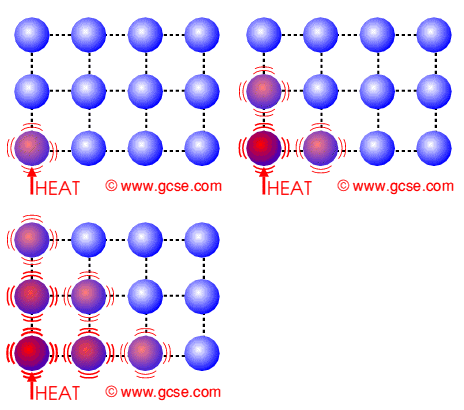
Every atom is physically bonded to its neighbours in some way. If heat energy is supplied to one part of a solid, the atoms vibrate faster.

As they vibrate more, the bonds between atoms are shaken more. This passes vibrations on to the next atom, and so on.

Eventually the energy spreads throughout the solid. The overall temperature has increased.

Conduction in metal


The electrons in piece of metal can leave their atoms and move about in the metal as free electrons. The parts of the metal atoms left behind are now charged metal ions. The ions are packed closely together and they vibrate continually. The hotter the metal, the more kinetic energy these vibrations have. This kinetic energy is transferred from hot parts of the metal to cooler parts by the free electrons. These move through the structure of the metal, colliding with ions as they go.

This is known as free electron diffusion.


Presence of free electrons in metals explains why good conductors like metals are capable of transfering thermal energy much faster than insulators.

Conduction in non-metals?

As density decreases so does conduction. Therefore, fluids (and especially gases) are less conductive. This is due to the large distance between atoms in a gas: fewer collisions between atoms means less conduction.

Conductivity of gases increases with temperature. Conductivity increases with increasing pressure from vacuum up to a critical point that the density of the gas is such that molecules of the gas may be expected to collide with each other before they transfer heat from one surface to another. After this point conductivity increases only slightly with increasing pressure and density.


Convection

Convection is the circulatory motion of a gas or liquid caused by the variation of its density and the action of gravity.

It cannot take place in solids, since neither bulk current flows nor significant diffusion can take place in solids.

When convection occurs, the part of the fluid near the heat source gets hot, the density of the hot fluid decreases and this part rises above the rest of the body of fluid. Colder fluid nearby comes to take the original place of the hot fluid, forming a convection current


Radiation


Do you ever wonder how the sun's energy reaches the Earth? The space between the sun and the Earth is a vacuum. So the sun's energy cannot be transferred to the Earth by either conduction or convection because both processes require need matter as a medium. The sun's energy is actually transferred to the Earth through a process called radiation.

Radiation is the process of heat transfer by electromagnetic waves.

All objects give out and take in thermal radiation, which is also called infrared radiation. The hotter an object is, the more infrared radiation it emits.

Infrared radiation is a type of electromagnetic radiation that involves waves. No particles are involved, unlike in the processes of conduction and convection, so radiation can even work through the vacuum of space.

Some surfaces are better than others at reflecting and absorbing infrared radiation.


Comparison of surfaces abilities to reflect and absorb radiation

Dark Surfaces
(Dull or black)

-Better absorbers of infrared radiation than Shiny Surfaces
-Better emitters of infrared radiation than Shiny Surfaces

Bright Surfaces
(Shiny or White)

-Poor absorbers of infrared radiation
-Poor emitters of infrared radiation

Factors affecting rate of infrared radiation

1.Colour and texture
e.g. Dull or black Surfaces are better absorbers of infrared radiation than Shiny Surfaces. Dull or black Surfaces are better emitters of infrared radiation than Shiny Surfaces.

2.Surface temperature
The higher the surface of the object relative to the surrounding temperature, the higher the rate of infrared radiation.

3.Surface area
e.g. Two object of the same mass and material, but with different surface area, the object with the larger surface area will emit infrared radiation at a higher rate.

Transfer of thermal energy


Transfer of thermal energy and its causes


Heat transfer is the movement of heat from one place to another. When an object is at a different temperature from its surroundings, heat transfer occurs so that the body and the surroundings reach the same temperature at thermal equilibrium. Such spontaneous heat transfer always occurs from a region of high temperature to another region of lower temperature


Examples:

A cup of coffee will cool down because it is giving out heat energy into the surroundings

A cold drinks can (taken out of the fridge) will warm up because it is taking in heat energy from the surroundings