Vector Diagrams
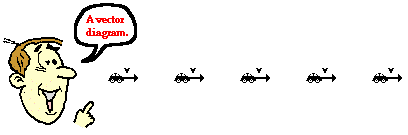
Vector diagrams are diagrams which depict the direction and relative magnitude of a
vector quantity by a vector arrow. Vector diagrams can be used to describe the velocity of a moving object during its motion.
Vector diagrams can be used to represent any vector quantity.
For example, acceleration, force, and momentum.
How to draw a vector diagram?
A vector arrow is used to represent the direction and relative size of a quantity. It will become a very important representation of an object's motion.
*In a vector diagram, the magnitude of a vector quantity is represented by the size
of the vector arrow. If the size of the arrow in each consecutive frame of the vector diagram is the same, then the magnitude of that vector is constant.
A straght arrow represents a vector motion and its length represents its magnitude.
The direction of the force is represented by the direction in which the arrowhead points.
A scale is used to represent the magnitude of the vector
( Magnitude represented by the scale must be accurate)
The direction of the drawing must also be accurate.
Adding Vectors
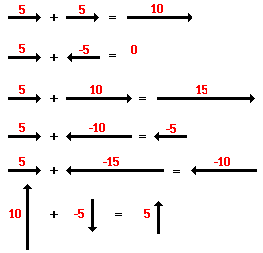
The net force is the vector sum of all the forces which act upon an object. That is to say, the net force is the sum of all the forces, taking into account the fact that a force is a vector and two forces of equal magnitude and opposite direction will cancel each other out.
The net force experienced by an object is determined by computing the vector sum of all the individual forces acting upon that object. That is the net force is the result(or resultant) of adding up all the force vectors to find a single vector that will produce the same effect as the two vectors added together.

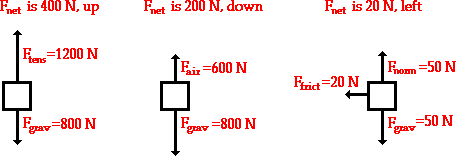
Observe in the diagram above that a downward vector will provide a partial or full cancellation of an upward vector. And a leftward vector will provide a partial or full cancellation of a rightward vector. The addition of force vectors can be done in the same manner in order to determine the net force (i.e., the vector sum of all the individual forces). Consider the three situations below in which the net force is determined by summing the individual force vectors which are acting upon the objects.

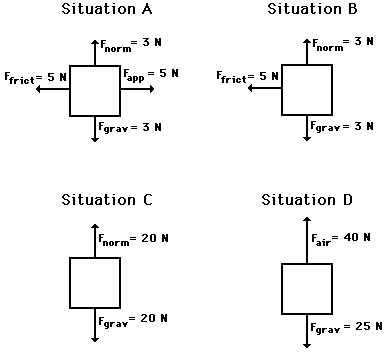
1. Free-body diagrams for four situations are shown below. For each situation, determine the net force acting upon the object. Click the buttons to view the answers.

Answer to situation A
The net force is zero Newtons. All the individual forces balance each other (i.e., cancel each other out).
Answer to situation B
The net force is 5 Newtons, left. The vertical forces balance each other (i.e., cancel each other out). The leftward force (friction) remains unbalanced.
Answer to situation C
The net force is zero Newtons. All the individual forces balance each other (i.e., cancel each other out).
Answer to situation D
The net force is 15 Newtons, up. The upward force of air resistance is only partially balanced by the downward force of gravity - 15 N of upward force remains unbalanced.
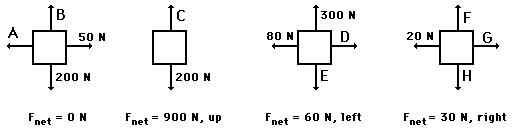
2. Free-body diagrams for four situations are shown below. The net force is known for each situation. However, the magnitudes of a few of the individual forces are not known. Analyze each situation individually and determine the magnitude of the unknown forces. Then click the button to view the answers.
 See Answer
How to add non-parallel vectors?
There are two equivalent ways to add vectors graphically: the
tip-to-tail method and the
parallelogram method. Both will get you to the same result, but one or the other is more convenient depending on the circumstances.
Tip-to-Tail Method
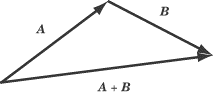
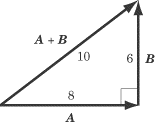
We can add any two vectors, A and B, by placing the tail of B so that it meets the tip of A. The sum, A + B, is the vector from the tail of A to the tip of B.

Note that you’ll get the same vector if you place the tip of B against the tail of A. In other words, A + B and B + A are equivalent.
Parallelogram Method
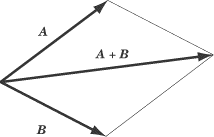
To add A and B using the parallelogram method, place the tail of B so that it meets the tail of A. Take these two vectors to be the first two adjacent sides of a parallelogram, and draw in the remaining two sides. The vector sum, A + B, extends from the tails of A and B across the diagonal to the opposite corner of the parallelogram. If the vectors are perpendicular and unequal in magnitude, the parallelogram will be a rectangle. If the vectors are perpendicular and equal in magnitude, the parallelogram will be a square.

Adding Vector Magnitudes
Of course, knowing what the sum of two vectors looks like is often not enough. Sometimes you’ll need to know the magnitude of the resultant vector. This, of course, depends not only on the magnitude of the two vectors you’re adding, but also on the angle between the two vectors.
Adding Perpendicular Vectors
Suppose vector A has a magnitude of 8, and vector B is perpendicular to A with a magnitude of 6. What is the magnitude of A + B? Since vectors A and B are perpendicular, the triangle formed by A, B, and A + B is a right triangle. We can use the Pythagorean Theorem to calculate the magnitude of A + B, which is

Adding Vectors at Other Angles
When A and B are neither perpendicular nor parallel, it is more difficult to calculate the magnitude of A + B because we can no longer use the Pythagorean Theorem. It is possible to calculate this sum using trigonometry, but SAT II Physics will never ask you to do this. For the most part, SAT II Physics will want you to show graphically what the sum will look like, following the tip-to-tail or parallelogram methods. On the rare occasions that you need to calculate the sum of vectors that are not perpendicular, you will be able to use the component method of vector addition, explained later in this chapter.
Example
Vector A has a magnitude of 9 and points due north, vector B has a magnitude of 3 and points due north, and vector C has a magnitude of 5 and points due west. What is the magnitude of the resultant vector, A + B + C?
First, add the two parallel vectors, A and B. Because they are parallel, this is a simple matter of straightforward addition: 9 + 3 = 12. So the vector A + B has a magnitude of 12 and points due north. Next, add A + B to C. These two vectors are perpendicular, so apply the Pythagorean Theorem:
The sum of the three vectors has a magnitude of 13. Though a little more time-consuming, adding three vectors is just as simple as adding two.