The transfer of energy as heat can take place via three processes: conduction,
convection, and radiation. In conduction and radiation, energy transfers occurs without
the transfer of mass.
Conduction
Conduction is the transfer of heat energy through a material - without the material itself moving.

Metals are good conductors of heat, but non-metals and gases are usually poor conductors of heat. Poor conductors of heat are called insulators. Heat energy is conducted from the hot end of an object to the cold end.
How does Conduction Occur?
Conduction takes place in all forms of matter, viz. solids, liquids, gases and plasmas, but does not require any bulk motion of matter. In solids, it is due to the combination of vibrations of the molecules in a lattice and the energy transport by free electrons. In gases and liquids, conduction is due to the collisions and diffusion of the molecules during their random motion.
Conduction in non-metal
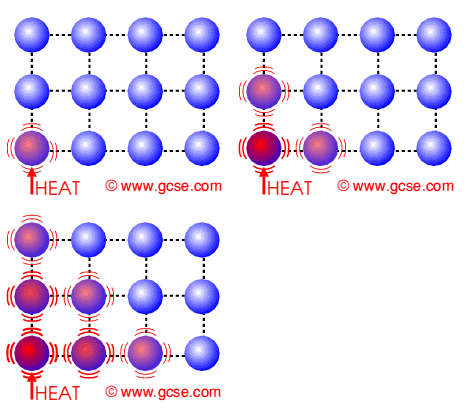
Every atom is physically bonded to its neighbours in some way. If heat energy is supplied to one part of a solid, the atoms vibrate faster.
As they vibrate more, the bonds between atoms are shaken more. This passes vibrations on to the next atom, and so on.
Eventually the energy spreads throughout the solid. The overall temperature has increased.
Conduction in metal
The electrons in piece of metal can leave their atoms and move about in the metal as free electrons. The parts of the metal atoms left behind are now charged metal ions. The ions are packed closely together and they vibrate continually. The hotter the metal, the more kinetic energy these vibrations have. This kinetic energy is transferred from hot parts of the metal to cooler parts by the free electrons. These move through the structure of the metal, colliding with ions as they go.
This is known as free electron diffusion.


Presence of free electrons in metals explains why good conductors like metals are capable of transfering thermal energy much faster than insulators.
Conduction in non-metals?
As density decreases so does conduction. Therefore, fluids (and especially gases) are less conductive. This is due to the large distance between atoms in a gas: fewer collisions between atoms means less conduction.
Conductivity of gases increases with temperature. Conductivity increases with increasing pressure from vacuum up to a critical point that the density of the gas is such that molecules of the gas may be expected to collide with each other before they transfer heat from one surface to another. After this point conductivity increases only slightly with increasing pressure and density.
Convection
Convection is the circulatory motion of a gas or liquid caused by the variation of its density and the action of gravity.
It cannot take place in solids, since neither bulk current flows nor significant diffusion can take place in solids.
When convection occurs, the part of the fluid near the heat source gets hot, the density of the hot fluid decreases and this part rises above the rest of the body of fluid. Colder fluid nearby comes to take the original place of the hot fluid, forming a convection current

Radiation

Do you ever wonder how the sun's energy reaches the Earth? The space between the sun and the Earth is a vacuum. So the sun's energy cannot be transferred to the Earth by either conduction or convection because both processes require need matter as a medium. The sun's energy is actually transferred to the Earth through a process called radiation.
Radiation is the process of heat transfer by electromagnetic waves.
All objects give out and take in thermal radiation, which is also called infrared radiation. The hotter an object is, the more infrared radiation it emits.
Infrared radiation is a type of electromagnetic radiation that involves waves. No particles are involved, unlike in the processes of conduction and convection, so radiation can even work through the vacuum of space.
Some surfaces are better than others at reflecting and absorbing infrared radiation.

Comparison of surfaces abilities to reflect and absorb radiation
Dark Surfaces
(Dull or black)
-Better absorbers of infrared radiation than Shiny Surfaces
-Better emitters of infrared radiation than Shiny Surfaces
Bright Surfaces
(Shiny or White)
-Poor absorbers of infrared radiation
-Poor emitters of infrared radiation
Factors affecting rate of infrared radiation
1.Colour and texture
e.g. Dull or black Surfaces are better absorbers of infrared radiation than Shiny Surfaces. Dull or black Surfaces are better emitters of infrared radiation than Shiny Surfaces.
2.Surface temperature
The higher the surface of the object relative to the surrounding temperature, the higher the rate of infrared radiation.
3.Surface area
e.g. Two object of the same mass and material, but with different surface area, the object with the larger surface area will emit infrared radiation at a higher rate.