Showing posts with label Unit 13 : Waves. Show all posts

Saturday, June 26, 2010

Wave Production and the ripple tank

The Ripple Tank


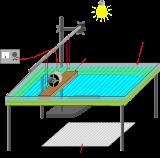
The ripple tank is a container that when filled with water permits the study of water waves.A concentrated light source positioned above the tank forms images of the waves on a screen beneath the tank.Wave crests and troughs project light and dark lines in the screen.



The crests act as converging lenses that focus light,producing the bright lines..The troughs act as diverging lenses that scatter light, producing the dark lines.
The depth at which the dipper is placed affects the amplitude of the waves, while the frequency of waves is determined by frequency of vibration of the dipper.

Refraction of waves and the depth of ripple tank


Refraction of waves involves a change in the direction of waves as they pass from one medium to another. Refraction is the bending of the path of the waves.It is accompanied by a change in speed and wavelength of the waves. It was mentioned that the speed of a wave is dependent upon the properties of the medium through which the waves travel. So if the medium (and its properties) are changed, the speed of the waves are changed.

The most significant property of water which would affect the speed of waves traveling on its surface is the depth of the water.

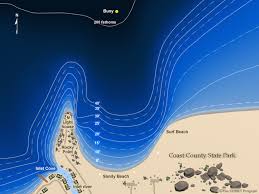
This boundary behavior of water waves can be observed in a ripple tank if the tank is partitioned into a deep and a shallow section. If a pane of glass is placed in the bottom of the tank, one part of the tank will be deep and the other part of the tank will be shallow. Waves traveling from the deep end to the shallow end can be seen to refract (i.e., bend), decrease wavelength (the wave fronts get closer together), and slow down (they take a longer time to travel the same distance). When traveling from deep water to shallow water, the waves are seen to bend in such a manner that they seem to be traveling more perpendicular to the surface.If traveling from shallow water to deep water, the waves bend in the opposite direction.


Water waves travel fastest when the medium is the deepest. Thus, if water waves are passing from deep water into shallow water, they will slow down and also the wavelength of the plane waves shorten.The frequency remains the same as it is determined by the dipper.Using the equation, v:f x L,the speed of the waves is therefore slower at the shallow water.


Refraction of waves can be demonstrated by placing the plastic sheet at an angle to the incoming waves .As observed earlier, the differene in the depth of water causes a change in speed of waves.Similar to light, when waves enter a region of shallow water at an angle, the waves refract.


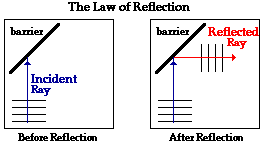
Reflection of waves can be demonstrated by placing a straight barrier upright in the water causing the incoming incident waves to be reflected.The law of reflection is obeyed and the Angle of incidence is equal to the angle of reflection.


Reflection, refraction and diffraction are all boundary behaviors of waves associated with the bending of the path of a wave. The bending of the path is an observable behavior when the medium is a two- or three-dimensional medium. Reflection occurs when there is a bouncing off of a barrier. Reflection of waves off straight barriers follows the law of reflection. Reflection of waves off parabolic barriers results in the convergence of the waves at a focal point. Refraction is the change in direction of waves which occurs when waves travel from one medium to another. Refraction is always accompanied by a wavelength and speed change. Diffraction is the bending of waves around obstacles and openings. The amount of diffraction increases with increasing wavelength.

Friday, June 25, 2010

Properties of Wave motion

Describing Waves


(click picture to get full view)

Crest or peak: The highest point reached by a wave.

Trough: The lowest point reached by a wave.

Phase : Any Two sources of wave motion are said to be in phase if, at any moment, they have the same fractional displacement from the rest position and are moving in the same direction. If both conditions are not met the sources are out of phase.
Any two crests or troughs are always in phase

Wavelength : The shortest distance between any two points in a wave that are in phase.In a transverse wave, the points are two successive crests or troughs.In longitudinal wave, it is the distance between two successive compressions or rarefactions.S.I. Unit: Metre (m)

Amplitude : The maximum displacement (difference between an original position and a later position) of the material that is vibrating. Amplitude can be thought of visually as the highest and lowest points of a wave.It is the height of a crest or the depth of the trough measured from rest position.S.I. Unit: Metre(m)

In a longitudinal Wave,


(click picture to get full view)

Compression : A point on a medium through which a longitudinal wave is traveling which has the maximum density.It is a region where the coils are pressed together in a small amount of space.

Rarefaction : a point on a medium through which a longitudinal wave is traveling which has the minimum density.It is a region where the coils are spread apart, thus maximizing the distance between coils.


The wavelength of a wave is the length of one complete cycle of a wave. For a transverse wave, the wavelength is determined by measuring from crest to crest. A longitudinal wave does not have crest; so how can its wavelength be determined? The wavelength can always be determined by measuring the distance between any two corresponding points on adjacent waves. In the case of a longitudinal wave, a wavelength measurement is made by measuring the distance from a compression to the next compression or from a rarefaction to the next rarefaction

Questions:

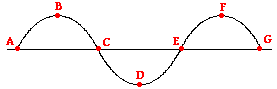
Consider the diagram below in order to answer questions #1-2.


1. The wavelength of the wave in the diagram above is given by letter ______.

ANS


2. The amplitude of the wave in the diagram above is given by letter _____.

ANS


3. Indicate the interval which represents one full wavelength.


a. A to C

b. B to D

c. A to G

d. C to G

ANS

Displacement-Distance Graph

A wave:


Any points on graph above the rest position show positive displacements
and any points on graph below the rest position show negative displacement.

(click picture to get full view)

Displacement-Time Graph


If we freeze the wave motion at various times, we can observe the up-and-down movements of points on transverse wave.If we trace the movement of wave over one second ,we can obtain the displacement-time graph of wave.

Period (T): It is the time for a particle on a medium to make one complete vibrational cycle. Period, being a time, is measured in units of time such as seconds, hours, days or years.

Frequency(f) : It refers to how often the particles of the medium vibrate when a wave passes through the medium. S.I. unit: Hertz (Hz)where 1 Hz is equivalent to 1 cycle/second.

Frequency = Number of cycles/Time Interval

(The period (T) is the time required to complete one full cycle.)

Period and frequency exhibit a reciprocal relationship.


Since the symbol f is used for frequency and the symbol T is used for period, these equations are also expressed as:


Higher the frequency, more the no. of waves produced in one second,T is shorter.

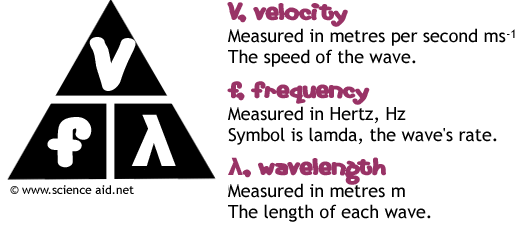
Wave Speed (v) : In a time of one period, a crest on a transverse wave will have moved a distance of one wavelength.

Hence,

Equation for the Speed of a wave :

v : L/T

where ,
v- wave speed
L- wavelength
T-Period

Since f:1/T,

v:f x L


S.I. unit : m/s

Wave front: It is the imaginary line on a wave that joins all points that are in the same phase.It is usually drawn by joining all the wave crests.Depending on the formation of waves, wavefront can be concentric circles,plane straight lines or any shape.


Questions:

1. As the frequency of a wave increases, the period of the wave ___________.

a. decreases

b. increases

c. remains the same

ANSWER

2.The period of the sound wave produced by a 440 Hertz tuning fork is ___________.


Answer


3.A child in a swing makes one complete back and forth motion in 3.2 seconds. This statement provides information about the child's

a. speed

b. frequency

c. period

ANSWER

4. A period of 5.0 seconds corresponds to a frequency of ________ Hertz.

a. 0.2

b. 0.5

c. 0.02

d. 0.05

e. 0.002

Answer

Thursday, June 24, 2010

Types of Waves

Types of Waves

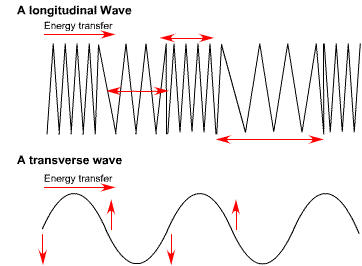
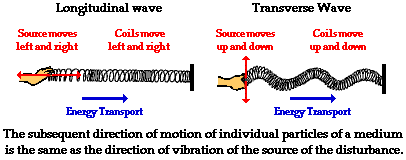
Two types of waves exist: transverse and longitudinal.Both of these wave-types are traveling disturbances, but they are different because of the way that they travel. As a wave travels through a medium, the particles that make up the medium are disturbed from their resting, or “equilibrium” positions.After either type of wave passes through a medium, the particles return to their equilibrium positions. Thus, waves travel through a medium with no net displacement of the particles in the medium.

Transverse Waves


(A transverse wave. The particles move in a direction that is perpendicular to the direction of wave propagation.)

A transverse wave is one that causes the particles of the surrounding medium to vibrate in a direction at right angles to the direction of the wave. In a transverse wave, the particles are disturbed in a direction perpendicular to the direction of source(Vibration).A water wave is an example of a transverse wave. As water particles move up and down, the water wave itself appears to move to the right or left.Another example of these types of waves are light waves.


Longitudinal Waves


(A longitudinal wave, made up of compressions - areas where particles are close together - and rarefactions - areas where particles are spread out. The particles move in a direction that is parallel to the direction of wave propagation.)

In a longitudinal wave, the particles are disturbed in a direction parallel to the direction that the wave propagates. A longitudinal wave consists of “compressions” and “rarefactions” where particles are bunched together and spread out, respectively.
The direction of the wave motion is parallel to the direction to the direction of vibration.
Sound Waves are an example of longitudinal waves.


Comparison between transverse and longitudinal waves
----------------------------------------
Transverse waves

Definition:
The particles of the medium vibrate
at right angles to the direction of
wave motion

Longitudinal waves

Definition:
The particles of the medium vibrate
parallel to the direction of wave
motion.
----------------------------------------
Transverse waves

Movement:
The wave is propagated in the form
of crests and troughs

Longitudinal waves

Movement:
The wave is propagated in the form
of compressions and rarefactions.
-----------------------------------------
Transverse waves

Medium:
This type of wave motion is possible
in solids and on liquid surfaces

Longitudinal waves

Medium:
This type of wave motion is possible
in any medium (solid, liquid or gas)
-----------------------------------------
Transverse waves

Polarization:
These waves Can undergo polarization

Longitudinal waves

Polarization:
These waves do not undergo polarization
-----------------------------------------

Questions:
1. A transverse wave is transporting energy from east to west. The particles of the medium will move_____.

a. east to west only

b. both eastward and westward

c. north to south only

d. both northward and southward
(See Answer)

2.A wave is transporting energy from left to right. The particles of the medium are moving back and forth in a leftward and rightward direction. This type of wave is known as a ____.

a. mechanical


b. electromagnetic

c. transverse

d. longitudinal
(See Answer)

3. Describe how the fans in a stadium must move in order to produce a longitudinal stadium wave.

ANSWER

4. If you strike a horizontal rod vertically from above, what can be said about the waves created in the rod?

a. The particles vibrate horizontally along the direction of the rod.

b. The particles vibrate vertically, perpendicular to the direction of the rod.

c. The particles vibrate in circles, perpendicular to the direction of the rod.

d. The particles travel along the rod from the point of impact to its end.

See Answer

Wave Formation

HOW ARE WAVES FORMED?

Wave motion

Wave motion is defined as the movement of a distortion of a material or medium, where the individual parts or elements of the material only move or propogate back-and-forth, up-and-down, or in a cyclical pattern.It is just the distortion moving, where one part influences the next.


Example:


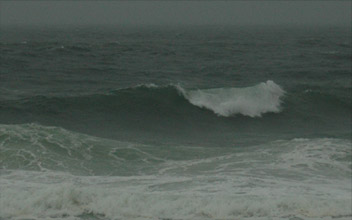
Probably the most familiar example of wave motion is the action of water waves. A boat at rest on the ocean moves up and down as water waves pass beneath it. The waves appear to be moving toward the shore. But the water particles that make up the wave are actually moving in a vertical direction. The boat itself does not move toward the shore or, if it does, it's at a much slower rate than that of the water waves themselves.

The energy carried by a water wave is obvious to anyone who has watched a wave hit the shore. Even small waves have enough energy to move bits of sand. Much larger waves can, of course, tear apart the shore and wash away homes.

Other Examples:

Wave motion on rope


A rope is fixed with one end to a wall and moving the other end up and down.Up and Down movements produce a vibration and oscillation.The rope waves produced move towards the wall while traveling up and down.In this case, the rope is the medium through which the waves move.The kinetic energy from the up-and-down movement is transferred by the wave without the rope itself moving from one end to another.

Waves in a ripple tank


In a ripple tank, a small dipper moves up and down the water surface.As a result, the water particles at the surface that are in contact with the dipper are made to move up and down.This up and down motion spreads to other parts of the water surface in the tank in the form of ripples.The kinetic energy from the up and down movement of the dipper is transferred to the water molecules in the surface.These water molecules then transfer the energy to the surrounding water molecules and so on.(Note: on the energy is transferred from the dipper to the water, not the water itself)


In a Nutshell...

We know that:
1.The source of a wave is a vibration or oscillation (Basically a disturbance to the medium)
2.Waves transfer energy from one point to another.
3.In waves,energy is transferred without the medium being transferred

Tuesday, June 22, 2010

What is a Wave?

Waves

What is a Wave?

A wave can be described as a disturbance that travels through a medium from one location to another location.It is made up of periodic motion,which is a motion repeated at regular intervals.One example of a periodic motion is the pendulum bob moving left to right and back to left.

It is thought of as a traveling disturbance.It travels energy from one place to another place transferring energy in the process.The source of any wave is a vibration or oscillation.


For example:

When a pebble is dropped in a pond, a few circular ripples, the disturbances in this case,move outward on the surface of the water.


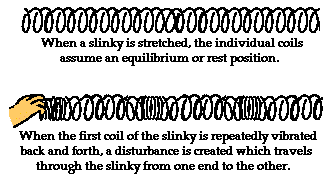
When the slinky is stretched from end to end and is held at rest, it assumes a natural position known as the equilibrium or rest position.

To introduce a wave into the slinky, the first particle is displaced or moved from its equilibrium or rest position. The particle might be moved upwards or downwards, forwards or backwards; but once moved, it is returned to its original equilibrium or rest position.

The act of moving the first coil of the slinky in a given direction and then returning it to its equilibrium position creates a disturbance in the slinky.

We can then observe this disturbance moving through the slinky from one end to the other. If the first coil of the slinky is given a single back-and-forth vibration, then we call the observed motion of the disturbance through the slinky a slinky pulse.

A pulse is a single disturbance moving through a medium from one location to another location. However, if the first coil of the slinky is continuously and periodically vibrated in a back-and-forth manner, we would observe a repeating disturbance moving within the slinky which endures over some prolonged period of time.

The repeating and periodic disturbance which moves through a medium from one location to another is referred to as a wave.