The center of gravity is a geometric property of any object.It is defined as the point at which its whole weight appears to act for any orientation of the object. It is the average location of the weight of an object.
In Physics we find it a lot easier to think of objects as point masses. We think of all the mass as being concentrated at the centre of gravity.

The green arrow is the line of action of the force from the centre of gravity. Force due to gravity on a mass is the weight.
When an object is pivoted at a corner,its weight causes a turning effect about the pivot.
However, if you place the pivot a particular position, it s weight has no turning effect. This position is the point at which the moment of its weight is
0 as its perpendicular distance between the pivot and the line of action of weight is 0.
Note that it is called the centre of gravity not centre of weight. This is because if the object were in space, it would still have mass but the weight differs due to the distance from the gravitational field strength
We can completely describe the motion of any object through space in terms of the translation of the center of gravity of the object from one place to another, and the rotation of the object about its center of gravity if it is free to rotate.
If the object is confined to rotate about some other point, like a hinge, we can still describe its motion.
If we allow an object to dangle freely from a single point, we find that the centre of mass is on a line vertically underneath the point from which the object is hung.

Now if we turn the rectangle so that it hangs off one of the holes in the corner, we can use the plumb line to trace a second line like this:

We can trace the line by hanging a plumb line (heavy object on a string) which always hangs vertically.

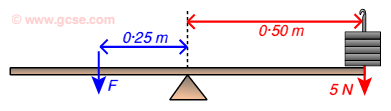
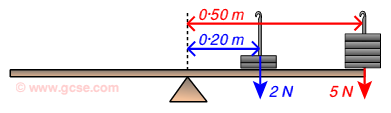
When solving problems involving Forces and moments,
Remember to note :
1. Center of gravity of objects
2. The pivot
3. the force applied
4. The Weight of the object
5. The moment of object
Stability
Stability is the extent to which an object resists toppling over. Stable objects do not topple over easily. When designing vehicles, engineers try to design so that the centre of mass is as low as possible. This makes vehicles less likely to turn over when going round corners.
Three cases of Equilibrium:
1. Stable Equilibrium
Place a Bunsen burner on its broad base (figure below). Push the top to one side and see what happens. You will notice that the burner does not fall off unless it is given a hard push. This is because the body is in stable equilibrium, it has a broad base, a heavy bottom, thus lowering its center of gravity. When the burner is tilted more and more, the C.G. gets raised and the burner falls back to make the C.G. as low as possible [Figure (a) below)].
a)Centre of Gravity Rises and then falls
b)the line of action of its weight lies inside its base area
c)The anti clockwise moment of its weight about tthe point of contact causes it to return to its original position
2. Unstable Equilibrium
Place the burner upside down as shown in figure below. A slight push causes the C.G. to be lowered and the burner begins to fall to make the C.G. as low as possible [Figure (b) below)].
a)Centre of Gravity falls and falls further.
b)the line of action of its weight lies outside its base area
c)The clockwise moments of its weigtht about the point of contact causes toppling
3. Neutral Equilibrium
Let the burner lie on its side as in figure below. Push it slightly and see what happens. On further pushing, the C.G. neither gets raised nor lowered. The burner just rolls maintaining its center of gravity at the same level. Objects like cylinders and cones lying on their side roll because they are in neutral equilibrium [Figure (c) below)].
a)Centre of Gravity neither rises nor falls; remains at the same level above the surface supporting it.
b)the line of action of its weight and opposing force coincides
c)No mements provided by its weigtht about the point of contact to turn the bunsen burner

Conditions for Stable Equilibrium
* The body should have a broad base.
* Center of gravity of the body should be as low as possible.
* Vertical line drawn from the center of gravity should fall within the base of
support.
Solved Examples
Example 1:
A uniform meter rod of weight 100 N carries a weight of 40 N and 60 N suspended from 20 cm and 90 cm mark respectively. Where will you provide a knife edge to balance the meter scale?
Suggested answer :
If we assume the fulcrum to be at 50 cm mark, then the moment due to the force at 90 cm mark is greater than the one at 20 cm mark. Therefore, the knife edge should be supported at a distance of 'X' cm away from 50 cm mark.

Taking moments about X,
40(30 + X) + 100 + X = 60 (40 - X)
120 + 4X + 10X = 240 - 6X (dividing by 10)
14X + 6X = 240 - 120
20X = 120
The knife edge should be provided at 56 cm mark.
Example 2 :
A see-saw of 4m is provided with a wedge at the center. Susan and Jason of weights 500 N and 300 N respectively are sitting on the same side of the fulcrum at 2 m and 1.5 m from center respectively. If Karl weighing 600 N is sitting on the opposite side at a distance of 2 m from the center where must Peter weighing 200 N sit to balance the see-saw?
Suggested answer :
Let Peter be at a distance of 'd' m away from center nearer to Karl as the moment on the opposite side is greater.

By the principle of moments,
(600 x 2) + (200 x d) = (500 x 2) + (300 x 1.5)
12 + 2d = 10 + 4.5 (dividing both sides by 100)
2d = 14.5 - 12
from the center near Karl.
Example 3:
Two ropes are attached to points P and Q on a wheel of radius 0.5 m which can turn about O. Equal forces of 10 N are applied on the ropes at P and Q. State whether the wheel will turn, if at all whether clockwise or anticlockwise. Support your answer with a scientific reason.
Suggested answer :
Moment due to force at P
= 10 x 0.5 = 5 N m (clockwise)
Moment due to force at Q.
= 10 x 0.4 = 4 N m (anticlockwise)
*moments of force on a wheel
The force P is tangential perpendicular distance from O = 0.5 m while the perpendicular distance OR from Q = 0.4 m. Hence, the clockwise moment being greater the wheel will turn in that direction.
(a) Center of gravity in loading a ship
When a ship floats in the water the forces of buoyancy and gravity balance each other because they are equal.
The following three diagrams show how loads affect the center of gravity and stability of a ship. A fully loaded ship [figure (a)] brings the center of gravity and the center of buoyant force close together making the ship stable.

When the ship is unloaded [figure (b) above] the center of the gravity and the center of buoyancy have moved far apart, then the ship will be unstable.
In the figure (c) above, weight of the flooded ballast tanks restore balance.
(b) As the C.G. of a body is raised the body becomes more unstable. This is because when the body is tilted the vertical line drawn from the C.G. falls outside the base.

For the same reason extra passengers are not allowed on the upper deck of a bus. If they are allowed to stand in the upper deck the C.G will be raised and the bus will be more unstable when it takes a sharp turn.

For the same reason even the height of a sports car is reduced to the minimum.

(c) Manufacturers make toys which appear to be unstable but are in fact very stable. For example, the rocking doll will come back to right position even if you tilt it completely on one side. This is because of its heavy base (low C.G).