Showing posts with label Unit 21: Electromagnetism. Show all posts

Sunday, January 2, 2011

Motor Coil Forces

Electric Motor

Look at the single coil of wire below. It is connected to a DC supply. Current flows, as shown by the red arrows.
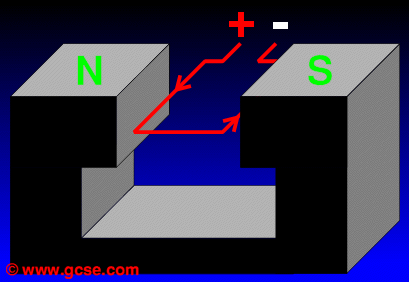


Use Fleming's Left Hand Rule to show that the left and right hand sides of the coil experience a force up and down.

Using the Left Hand Rule, you should work out that the wire experiences the following forces:
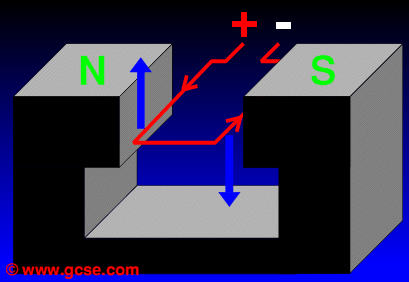


As a result, it will rotate clockwise. Let's see what will happen next.

When the coil moves into the vertical postition (as long as the current is still flowing) the forces acting on the wires remain :
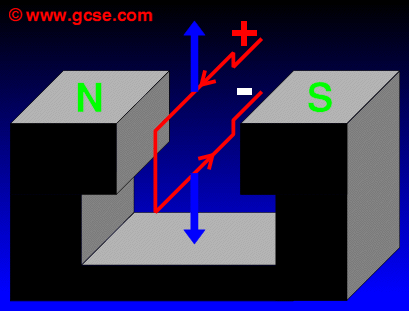


The forces act against each other: the coil will stop rotating! How then can a real motor keep going in the same direction? And how does it not twist its wires into a mess?

The Commutator

The answer is to use a commutator. This device prevents the wires from twisting. More importantly it actually allows the coil to keep rotating in one direction!
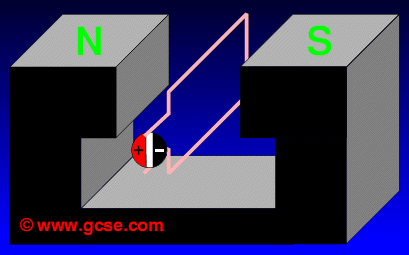


The one shown is a split-ring commutator. It has two halves, each connected to the power supply, completing the coil circuit. The coil is able to turn smoothly around it.

The commutator is made from two round pieces of copper, one on each side of the spindle. A piece of carbon (graphite) is lightly pushed against the copper
to conduct the electricity to the armature. The carbon brushes against the copper when the commutator spins.

In the vertical position there is no current as the coil has lost its connections to the commutator. Since the coil was already moving, it keeps turning. Think about riding a bike - stop pedalling and you don't stop moving for quite some time.

As the motor rotates, first one piece of copper, then the next connects with the brush every half turn. The wire on the left side of the armature always has current flowing in the same direction, and so the armature will keep turning in the same direction.


The pieces of copper are held apart in the centre and do not touch each other.
They look like a ring of copper which is split down the middle. This is why it is called a split - ring commutator.

Summary points: split-ring commutators reverse the direction of the current in the coil each half turn. This allows the motor coil to rotate continuously in one direction.

To increase the turning effect of the coil in the motor:

1.Insert a soft Iron core or cylinder into coil - to concentrate the magnetic field lines.

2. Increase the number of turns in the coil.

3. Increase the current in the coil.

Saturday, January 1, 2011

Electromagnetism

Magnetic Effect of a current


Th­e basic idea behind an electromagnet is extremely simple:Pass an electrical current through a wire and something amazing happens: a magnetic field is produced! You can show this by passing current through an insulated wire near a compass, although iron filings will also do.

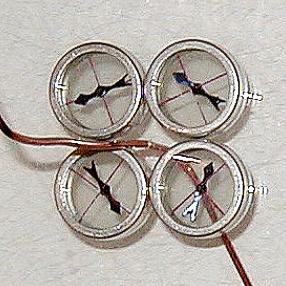
Turning the current on and off will cause the compasses to deflect. Shown below are four compasses near a wire that comes towards the camera.


Magnetic Field around a straight wire


The shape of the magnetic field around a current-carrying conductor is rather curious: it is circular. The strongest deflection of compasses happens nearest to the wire.

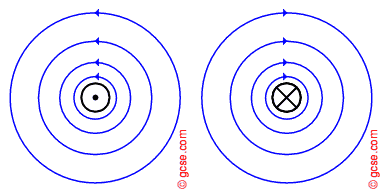
We can draw the field as a series of concentric circles around the wire as shown below. Notice that the circles are closer together nearer the wire: this indicates a stronger field.


Rather than awkwardly draw the field in some sort of 3D image, we normally draw them as if seeing the wire from above or below, as shown here:


The animation clearly shows that reversing the direction of the current reverses the direction of the magnetic field.

The magnetic field of a long, straight current-carrying wire is stronger:
(the field becomes stronger so we would draw more lines closer together)

1.increase the size of the current

2.when a larger current flows through the wire


Field Directions

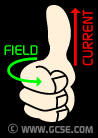
The direction of the field lines shows how a compass would line up if placed at that point. We can use the right hand grip rule to remember the relationship between current and field around a wire:


Grab the wire with your right fist (as shown), thumb pointing up: this is the direction of conventional current ( + to - ).

Your curled up fingers show the direction of the field.

An alternative way of remembering this is called the corkscrew rule: when screwing in a corkscrew to a bottle of wine, the point indicates the direction of the current, the the turning the field direction.

N.B. This does not, of course, work with left-handed corkscrews!


Magnetic field pattern around a flat coil and solenoid

When an electric current flows in a wire it creates a magnetic field around the wire.
By winding the wire into a coil we can strengthen the magnetic field. Electromagnets are made from coils like this, Making an electromagnet stronger.


A strong field can be made by coiling the wire around a piece of soft iron.
This electromagnet is sometimes called a solenoid. The shape of the magnetic field is the same as a bar magnet.


We can make an electromagnet stronger by doing these things:

* wrapping the coil around an iron core

* adding more turns to the coil

* increasing the current flowing through the coil.


Force on Current-carrying conductors


Place a current-carrying conductor in an external magnetic field (perhaps between two bar magnets), and the fields will push against each other. This force is incredibly important: it is the basis for all electric motors!


Normally the external field is fixed in place, so the force is only seen to act on the wire: moving it up or down. However, remember that forces come in pairs - the permanent magnets will experience the force too.


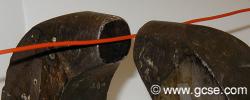
In the image above, the wire is at 90° to the direction of the magnetic field (which is between the poles of a horseshoe magnet).

Current is flowing to the left; the magnetic field diagonally towards us. This results in an upwards force on the wire.


If we reverse the direction of the current, the magnetic field around the wire reverses (surprise!). This reverses the force, so the wire deflects down:


A rather neat result of this effect is that if we pass alternating current (ac) through the wire, the direction of the force will continuously change. In the UK, ac is at a frequency of 50 Hz, so the wire can be seen vibrating up and down. This effect is used in speakers!

Fleming's Left Hand Rule


We have three directions to worry about: current, field and force. At GCSE we make sure the wire is held at 90° to the direction of the field. This makes life easier: the force is either up or down.

Current: dc - this is always from + to -
Field: direction is always from N to S.
Force: depends on how the other two align.

The left hand rule can be used to show how these three are related in a motor.