Showing posts with label Unit 07 : Pressure. Show all posts

Sunday, August 8, 2010

Gas Pressure

Atmospheric Pressure

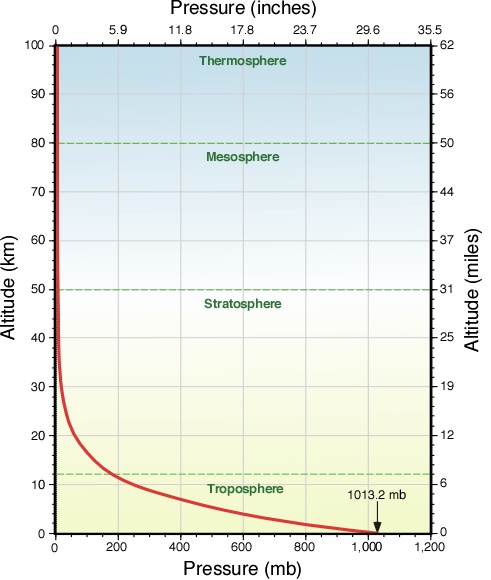
The earth's atmosphere exerts a force on everything within it. This force, divided by the area over which it acts, is the atmospheric pressure. The atmospheric pressure at sea level has an average value of 1,013.25 millibars. Expressed with other units, this pressure is 14.7 lb per square inch, 29.92 inches of mercury, or 1.01 × 10⁵ pascals-this is commonly referred to as 1 atmosphere which is equivalent to placing a 1kg mass(10N weight) on an area of 1 centimeter squared.

Atmospheric pressure decreases with increasing altitude: it is half of the sea level value at an altitude of about 3.1 mi (5 km) and falls to only 20% of the surface pressure at the cruising altitude of a jetliner. Atmospheric pressure also changes slightly from day to day as weather systems move through the atmosphere.


How much pressure are you under?


Earth's atmosphere is pressing against each square inch of you with a force of 1 kilogram per square centimeter (14.7 pounds per square inch). The force on 1,000 square centimeters (a little larger than a square foot) is about a ton!


Why doesn't all that pressure squash me?


Remember that you have air inside your body too, that air balances out the pressure outside so you stay nice and firm and not squishy.

The Natural Pressure within our bodies is also about 1 atmosphere.As such, the internal pressure of our bodies is able to balance out the atmospheric pressure that acts on us.If this natural pressure was not present within our bodies, we would be crushed to death by the atmosphere.

Air pressure can tell us about what kind of weather to expect as well. If a high pressure system is on its way, often you can expect cooler temperatures and clear skies. If a low pressure system is coming, then look for warmer weather, storms and rain.

What Happens if Air Pressure Changes?

Our bodies are unable to adjust quickly to changes in atmospheric pressure, and we may suffer injuries or altitude sickness if the changes are too great.

For Example

We know that air pressure in High altitudes is much lower than 1 atmosphere.Hence, to safeguard the passengers on an aeroplane, the pressure in the aircraft is gradually increased as the plane ascends.This way, the people on board will not experience a great pressure change.


Why do my ears pop?

If you've ever been to the top of a tall mountain, you may have noticed that your ears pop and you need to breathe more often than when you're at sea level. As the number of molecules of air around you decreases, the air pressure decreases. This causes your ears to pop in order to balance the pressure between the outside and inside of your ear. Since you are breathing fewer molecules of oxygen, you need to breathe faster to bring the few molecules there are into your lungs to make up for the deficit.

As you climb higher, air temperature decreases. Typically, air temperatures decrease about 3.6° F per 1,000 feet of elevation.



Simple Pressure Related Applications:

DRINKING STRAW:

A drinking straw is used by creating a suction with your mouth. Actually this causes a decrease in air pressure on the inside of the straw. Since the atmospheric pressure is greater on the outside of the straw, liquid is forced into and up the straw.


SIPHON:

With a siphon, water can be made to flow "uphill". A siphon can be started by filling the tube with water (perhaps by suction). Once started, atmospheric pressure upon the surface of the upper container forces water up the short tube to replace water flowing out of the long tube.


Barometer


Any instrument that measures air pressure is called a barometer. The first measurement of atmospheric pressure began with a simple experiment performed by Evangelista Torricelli in 1643.

In his experiment, Torricelli immersed a tube, sealed at one end, into a container of mercury (see Figure 7d-2 below). Atmospheric pressure then forced the mercury up into the tube to a level that was considerably higher than the mercury in the container.

Torricelli determined from this experiment that the pressure of the atmosphere is approximately 30 inches or 76 centimeters (one centimeter of mercury is equal to 13.3 millibars). He also noticed that height of the mercury varied with changes in outside weather conditions.


Atmospheric pressure is not expressed in terms of pascal(PA) but as the height of the mercury column in the barometer.We can express 1 atmosphere as 760 mm Hg or 76 cm Hg(Hg is the chemical symbol for mercury).To convert mm Hg to Pascals, we simply convert mm Hg to 10(to the power of -3) Hg, and multiply the density of mercury in kg/cubic meter and the gravitational field strength,g in N/Kg.


Manometers

Manometers measure a pressure difference by balancing the weight of a fluid column between the two pressures of interest. Large pressure differences are measured with heavy fluids, such as mercury (e.g. 760 mm Hg = 1 atmosphere). Small pressure differences, such as those experienced in experimental wind tunnels or venturi flowmeters, are measured by lighter fluids such as water (27.7 inch H2O = 1 psi; 1 cm H2O = 98.1 Pa).

To calculate the pressure indicated by the manometer, enter the data below. (The default calculation is for a water manometer with a 10 cm fluid column, with the answer rounded to 3 significant figures.):


Equations used in the Calculation

The pressure difference between the bottom and top of an incompressible fluid column is given by the incompressible fluid statics equation,


where g is the acceleration of gravity (9.81 m/s2).

Pressure In Liquids

Fluids

A fluid is a substance that cannot maintain its own shape but takes the shape of its container. Fluid laws assume idealized fluids that cannot be compressed.
Density and pressure

Density and Pressure

The density (ρ) of a substance of uniform composition is its mass per unit volume: ρ = m/ V. In the SI system, density is measured in units of kilograms per cubic meter.

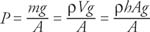
Imagine an upright cylindrical beaker filled with a fluid. The fluid exerts a force on the bottom of the container due to its weight.Pressure at a point in a fluid is directly proportional to the density of the fluid and the depth of the point Pressure is defined as the force per unit area: P = F/ A , or in terms of magnitude, P = mg/A, where mg is the weight of the fluid.

The SI unit of pressure is N/m2, called a pascal.

The pressure at the bottom of a fluid can be expressed in terms of the density (ρ) and height (h) of the fluid:


or

P = ρ g h,

where
P is the fluid pressure at a point,
ρ is the density of the fluid,
g is the acceleration due to gravity, and
h is the depth of the point.

The pressure at any point in a fluid acts equally in all directions. This concept is sometimes called the basic law of fluid pressure.

From the equation,
We can see that pressure in liquid increases with the depth and density of liquid
but not the volume or cross sectional area of liquid.

A liquid will always settle at a common level.If the height of water is different across the columns, the pressure difference will cause the height of each column to drop or rise until a common level is reached.

At Equilibrium, or at any point along the same vertical height, the pressure will be the same.


Transmission of pressure in liquids

Pascal's principle

Pascal's principle may be stated thus:
The pressure applied at one point in an enclosed fluid under equilibrium conditions is transmitted equally to all parts of the fluid.

This is because fluids such as liquids are incompressible.This means that if pressure is applied to a trapped liquid, the pressure will be transmitted to all other parts of the liquid.

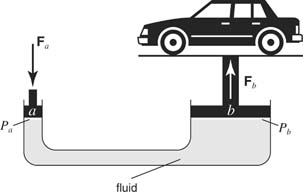
This rule is utilized in hydraulic systems. In Figure 1 , a push on a cylindrical piston at point a lifts an object at point b.


Figure 1
Pascal's principle is used to easily lift a car.

Let the subscripts a and b denote the quantities at each piston. The pressures are equal; therefore,

P a = P b

Substitute the expression for pressure in terms of force and area to obtain

f a / A a = ( F b / A b )

Substitute π r2 for the area of a circle, simplify, and solve for

F b : F b =( F a )( r b 2/ r a 2)

Because the force exerted at point a is multiplied by the square of the ratio of the radii and

r b > r a ,

a modest force on the small piston a can lift a relatively larger weight on piston b

Pressure

Pressure

Pressure is the force on an object that is spread over a surface area.

The equation for pressure is the force divided by the area where the force is applied. Although this measurement is straightforward when a solid is pushing on a solid, the case of a solid pushing on a liquid or gas requires that the fluid be confined in a container. The force can also be created by the weight of an object.

The smaller the sufface area, the greater is the pressure. This is because the force is spread over a smaller area.

Pressure of solid on a solid

When you apply a force to a solid object, the pressure is defined as the force applied divided by the area of application.Hence,

Pressure depends on two things:

* the Force (in Newtons) and

* the Area it's pressing on (in square metres)

The equation for pressure is:

P = F/A

where

* P is the pressure
* F is the applied force
* A is the surface area where the force is applied
* F/A is F divided by A

The unit of pressure is the pascal

1 Pascal means 1 Newton per square metre
So, 1 Pa = 1 N m-2.
Another unit of pressure that is used is bar. Note that 1 bar = 105 Pa and 1 bar = 1000 millibars.

The pascal is also a unit of stress and the topics of pressure and stress are connected.

* Bed of nails (not really pressure but shear strain?)
* Finger bones are flat on the gripping side to increase surface area in contact and thus reduce compressional stresses

Pressure is isotropic, which means that it acts equally in all directions.
Thus, liquids exert the same pressure in all directions at a given depth.

For example, if you push on an object with your hand with a force of 20 pounds, and the area of your hand is 10 square inches, then the pressure you are exerting is
20 / 10 = 2 pounds per square inch.


You can see that for a given force, if the surface area is smaller, the pressure will be greater. If you use a larger area, you are spreading out the force, and the pressure (or force per unit area) becomes smaller.

Here's an example:

The force on the bench is the weight of the block: 80 N
The area it's pressing on is the base area of the block which is 2 square metres.

So the pressure on the bench is

80 ÷ 2 = 40 Pascals


Notice that a large force might only create a small pressure if it's spread out over a wide area.Also, a small force can create a big pressure if the area is tiny.

Try these Questions:

1) An office safe has a weight of 500N. If the area of the base is 1.25 square metres, what is the pressure on the floor of the office?

Answer

2) A physics teacher has a weight of 800N. If his feet have an area of 0.025 square metres each, what pressure does he exert on the ground? (Remember, he has two feet!)

Answer

Some Applications of Pressure

Using Pressure

* When the area is small, a moderate force can create a very large pressure. This is why a sharp knife is good at cutting things: when you push the very small area of the sharp blade against something, it creates a really large pressure.

* Ice skates have sharp edges, and thus a small area in contact with the ice.
This means that your weight creates a very large pressure on the ice, far more than if you were standing in ordinary shoes.
Ice has an unusual property: it can melt under pressure, even if it's below 0°C. When you're ice skating, you're actually skating on a layer of water that you've just melted, which quickly re-freezes when you move on (you're not skating on ice at all!) This is called regelation, and means that there's very little friction as you skate along.

* Even a slender supermodel can damage floors by walking on then in high-heeled shoes. This is because the area of the heel is small, so you can easily create enough pressure to cause a dent in the floor.
The pressure can be greater than if an elephant was standing there, even though the force is much less. So you should be able to figure out why elephants and camels have large feet.